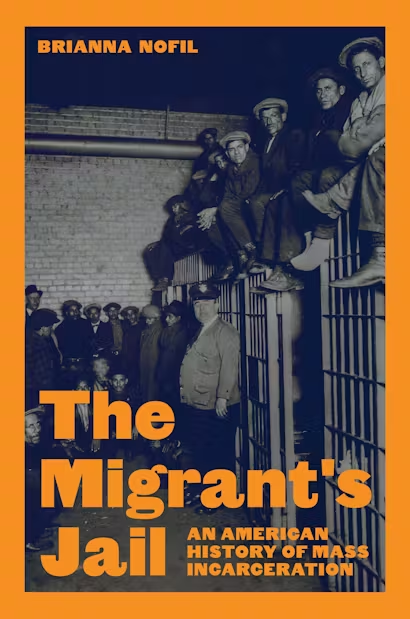
On a spring evening at Washington, D.C.’s historic True Reformer Building — the first building in the United States designed, financed, built, and owned by the African American community after Reconstruction — a D.C. crowd gathered for what would prove to be one of the most illuminating and unsettling conversations about American immigration policy in recent memory. The April 30th panel discussion centered on Professor Brianna Nofil’s groundbreaking book, The Migrant’s Jail: An American History of Mass Incarceration, hosted by the nonprofit Amica Center for Immigrant Rights — a legal advocacy organization that provides representation and support to immigrants in detention and facing deportation. What emerged over the course of the evening was not merely a book talk, but a profound reckoning with how deeply the practice of detaining migrants is woven into the fabric of American history — and how urgently we need to confront its present-day manifestations.
The panel brought together three voices whose combined expertise spans historical scholarship, legal advocacy, and frontline immigration work: Professor Nofil herself, an assistant professor of history at William & Mary; Michael Lukens, Executive Director of the Amica Center; and Ana Dionne-Lanier, Managing Attorney at the Amica Center for Immigrant Rights. Together, they painted a picture that challenges nearly everything most Americans believe about when, why, and how immigration detention became central to U.S. policy.
Shattering the Conventional Narrative
Perhaps the most striking revelation of the evening was Professor Nofil’s fundamental reframing of immigration detention’s origins. The conventional wisdom holds that immigration detention emerged alongside — or as a consequence of — the mass incarceration boom that began in the 1970s and 1980s. This narrative suggests that detention is a relatively recent phenomenon, tied to tough-on-crime politics and the war on drugs.
Nofil’s research demolishes this timeline. As she explained during the panel, immigration detention has deep historical roots stretching back to the Chinese Exclusion Act of the late 19th century — predating the modern mass incarceration era by nearly a century. “Migrant detention has existed since the early implementation of U.S. immigration laws,” she noted, directly contradicting “the common narrative that it emerged alongside mass incarceration.” This is not a minor historical footnote; it fundamentally changes how we understand both immigration enforcement and the carceral state in America.
From its very inception, the federal government’s approach to immigration control relied on a partnership with local law enforcement that should sound disturbingly familiar to contemporary observers. Nofil described how “federal immigration enforcement initially relied on local law enforcement, including sheriffs and county jails, especially in rural areas.” This wasn’t a systematic federal detention apparatus, but rather a patchwork system held together by financial incentives. As she emphasized, “early immigration detention operations were driven by financial incentives for local officials rather than systematic federal detention facilities.”
The implications are profound. What we’re witnessing today isn’t an aberration or a departure from American values, but rather the continuation and expansion of a system that has always been part of how America enforces its borders and defines who belongs within them.
The Staggering Scale of Contemporary Detention
If the historical context provided by Professor Nofil was sobering, the contemporary reality described by Ana Dionne-Lanier was nothing short of alarming. Drawing on her extensive experience providing legal representation to detained individuals, Dionne-Lanier reported stark numbers: ICE detention facilities now hold over 60,000 people nationwide — figures that have since surged past 72,000 as of early 2026, the highest numbers ever recorded.
Let that number sink in: tens of thousands of human beings, held in jail-like conditions, categorized by security levels, identified by numbers rather than names. As Dionne-Lanier described them, these facilities operate as “jail-like environments with people categorized by security levels and identification numbers.” These are not abstract statistics, but fathers and mothers, sons and daughters — people who came to America seeking safety or opportunity, now warehoused in a system that treats them as threats to be managed rather than human beings with rights and dignity.
Even more damning is what the data reveals about who is actually being detained. Dionne-Lanier shared a particularly troubling statistic: 73–75% of currently detained individuals pose no risk. Read that again: three-quarters of the people locked up in immigration detention facilities are there despite posing no danger to public safety. This raises the most fundamental question about the entire system: if detention isn’t about public safety, what is it about?
The conditions within these facilities, as Dionne-Lanier described them, are precisely what one would expect from a system operating at such scale with so little accountability. She explained how “how certain facilities she works with house large numbers of people in cramped conditions, leading to health issues including COVID outbreaks during the pandemic.” During the COVID-19 pandemic, these detention centers became vectors for disease transmission, with outbreaks spreading rapidly through populations that had no ability to socially distance or protect themselves. The cruel irony, as the panelists noted, is that throughout American history, migrants have been blamed for bringing disease — yet it is the detention system itself that creates the conditions for illness to flourish.
The Economics of Detention: How Communities Become Complicit
One of the most nuanced and troubling aspects of the discussion concerned how immigration detention facilities impact — and become embedded in — local communities. This is where the moral clarity of opposing detention runs headlong into the messy reality of economic dependence and community survival.
Professor Nofil explained the strategic calculus behind facility placement: “The Immigration Service intentionally placed facilities in areas with economic desperation,” citing Louisiana as an example. For these communities, a detention facility represents jobs for correctional officers and administrative staff, property tax revenue, and the economic activity that comes with a major institution.
The result is a devil’s bargain. Communities become economically dependent on the continued operation of facilities that exist to detain people who, in the vast majority of cases, pose no threat. Nofil elaborated on the consequences: “These facilities can affect local finances, including property taxes,” and highlighted “the challenges communities face when facilities close, such as job losses for correctional officers and administrative staff.”
This dynamic creates a political economy of detention that is remarkably difficult to dismantle. It’s not enough to demonstrate that detention is unjust, ineffective, or cruel. Reformers must also grapple with the question of what happens to the communities that have been made dependent on this system. As the panelists acknowledged, advocates face “the complex challenge of dismantling detention systems while addressing the economic hardship that closure would create for affected communities.”

The historical parallel here is instructive. Just as communities in the South became economically dependent on slavery, and later on convict leasing and chain gangs, contemporary rural communities have been made dependent on immigration detention. In each case, the economic interests of a community become aligned with the continued oppression of a vulnerable population. Breaking this cycle requires not just moral argument but economic alternatives — a Marshall Plan for communities that have been hollowed out and offered detention facilities as their only lifeline.
The Rhetoric of Threat: From Disease to Crime to Terrorism
Throughout the evening, the panelists returned repeatedly to the question of how detention has been justified to the American public. What emerged was a pattern of shape-shifting rhetoric that adapts to the anxieties of each era while serving the same fundamental purpose: marking certain groups of migrants as threats that must be contained.
In the late 19th century, Professor Nofil explained, “Chinese migrants were blamed for disease outbreaks” — a justification for their exclusion and detention as a matter of public health. The panel noted the bitter irony that “detention centers today do indeed produce illness due to their harsh conditions.”
In the 1980s, the narrative shifted dramatically. Nofil described “a pivotal moment in 1980 when 125,000 Cubans fled to South Florida, which shifted the narrative around asylum seekers and led to changes in how the U.S. handles refugees, including the implementation of mandatory detention for those without clear asylum cases.”
The post-9/11 era brought perhaps the most dramatic expansion of immigration detention. As Nofil explained, “post-9/11 policies significantly expanded immigration enforcement by connecting virtually any criminal offense to immigration concerns, leading to a dramatic increase in detentions.” The rhetoric of terrorism provided cover for connecting immigration to national security in ways that dramatically expanded the detention system. You can read related TANTV reporting on how ICE checkpoints have expanded across D.C. under the current administration.
Dionne-Lanier offered a particularly damning assessment based on her professional experience: “While enforcement has always been the primary focus regardless of political changes,” current enforcement practices “represent the worst period in [her] career.” This is especially troubling given that, as she noted, “statistics show 73–75% of currently detained individuals pose no risk.”
Legal Frameworks and the Struggle for Accountability
The discussion of legal challenges to immigration detention revealed both the tools available to advocates and the significant obstacles they face. The panelists discussed “the historical role of habeas corpus in immigration cases, particularly during the Chinese exclusion era,” which “provides important legal precedents for challenging detention.” These precedents establish that even non-citizens have certain constitutional protections and that detention cannot be indefinite or arbitrary.
However, as Dionne-Lanier explained, the current landscape is particularly challenging. She noted that “current policies have significantly restricted access to detained individuals and limited support services compared to previous administrations.” This restriction of access serves to insulate the detention system from scrutiny and accountability. The Amica Center has been an active litigant in federal court, challenging the Department of Justice over these very restrictions.
When asked about detention duration, Dionne-Lanier provided important context: “Detention times vary significantly based on individual cases and country of origin, with an average of about a month, though some cases can take much longer.” This variability itself raises due process concerns: why should similarly situated individuals face vastly different detention periods based on factors largely beyond their control?
Legal challenges to detention practices continue, but they face an uphill battle. Courts have generally deferred to the executive branch on immigration matters, granting broad discretion to immigration authorities. Advocates must thread a needle — arguing that detention violates constitutional protections while navigating a legal framework that treats immigration enforcement as a special category deserving of minimal judicial oversight.

Resistance and the Path Forward
Despite the grim picture painted by the statistics and historical analysis, the evening concluded on a note of determined, if cautious, hope. The panelists discussed “various forms of resistance to detention practices, including community organizing and legal challenges,” as well as “providing legal support to detained individuals.”
Community organizing has proven particularly important. Locally, Montgomery County unanimously passed the ICE Out Act, banning private ICE detention centers from operating within county limits. Prince George’s County passed a six-bill immigration protection package restricting ICE access to county property — offering what TANTV News has called “the ICE firewall playbook every county in America can now follow.” A federal judge also halted construction of a 1,500-bed ICE detention facility near Williamsport, Maryland, in March 2026. These efforts don’t dismantle the detention system, but they create spaces of resistance and solidarity that challenge its logic and provide concrete support to those affected.
Legal advocacy, while facing significant obstacles, continues to push the boundaries of what’s possible. Organizations like the Amica Center provide representation to detained individuals who would otherwise navigate the immigration system alone — a system so complex that immigration judges themselves have acknowledged it is nearly impossible to navigate without legal counsel. This representation doesn’t just help individual clients; it also creates a record of the system’s failures and injustices that can support broader reform efforts.
The question-and-answer session that concluded the event revealed an audience hungry for actionable next steps. The panelists’ responses emphasized both the complexity of the system and the multiple entry points for engagement — from supporting legal advocacy organizations like the Amica Center to pressuring elected officials to participating in community organizing efforts.
Reckoning with an American Institution
What made this event so powerful was its refusal to treat immigration detention as a policy problem that can be solved through technical fixes or administrative reforms. By situating contemporary detention within its full historical context, Professor Nofil’s work — and the panel’s discussion of it — forces us to confront immigration detention as an American institution: one that has evolved and adapted over more than a century but has never fundamentally changed its purpose. As El País noted in a December 2024 interview with Nofil, “there’s going to be massive amounts of money made at every step” of this system’s expansion.
This historical perspective is both sobering and clarifying. It’s sobering because it reveals that the current crisis isn’t an aberration that can be fixed by returning to some imagined better past. There is no golden age of humane immigration enforcement to which we can return. The system has always been built on detention, has always relied on local complicity, and has always justified itself through rhetoric about threats and dangers.

But this perspective is also clarifying because it helps us understand what real reform would require. We can’t tinker around the edges of a system that is functioning exactly as designed. We need to imagine and build something fundamentally different — an approach to immigration that doesn’t begin with the assumption that migrants are threats to be detained, that doesn’t profit from human suffering, and that doesn’t make communities economically dependent on incarceration.
The Moral Imperative
Yet for all the complexity and difficulty, the moral imperative remains clear. We are currently operating the largest immigration detention system in American history, holding tens of thousands of people in conditions that breed illness and despair, with three-quarters of them posing no security risk whatsoever. This is happening not in spite of American values, but as an expression of how America has always treated those it deems excludable.
Professor Nofil’s book, and the conversation it sparked at the True Reformer Building, offers us a choice. We can continue to treat immigration detention as a necessary evil — a regrettable but unavoidable tool of border enforcement. Or we can recognize it for what it is: a system of mass incarceration that predates and parallels the better-known system of criminal incarceration, one that has always served to mark certain people as less than fully deserving of rights and dignity.
The work of organizations like the Amica Center, providing legal representation and advocacy for detained individuals, offers a model of resistance grounded in the recognition of human dignity. Every person they represent, every case they take, is an assertion that detained migrants are not numbers or security threats, but human beings deserving of due process and humane treatment. Support the Amica Center here.
As the audience filed out of the True Reformer Building that evening, they carried with them not just information about immigration detention, but a challenge: to see this system clearly, to understand its deep roots in American history, and to commit to the long, difficult work of building something better. The conversation sparked by The Migrant’s Jail is one that America desperately needs to have — not just in academic settings or among advocates, but in communities across the country.
Because ultimately, immigration detention is not just an immigration issue or a criminal justice issue. It is a question about what kind of country we want to be — about whether we can break free from patterns of exclusion and incarceration that stretch back more than a century, and whether we can imagine and create systems that treat all people, regardless of where they were born or how they arrived, with dignity and justice.
The tens of thousands of people currently detained in ICE facilities are waiting for an answer.
TANTV Local is tracking anti-ICE legislation across the DMV and nationally. Follow our coverage at tantvnews.com.
This TANTVNews immigration coverage was made possible by a grant from URL Collective, a nonprofit supporting local, diverse media.